By Julia Schwarz
Abhishek Bhattacharjee, an expert in computer architecture, operating systems and neurotechnology, joined Princeton as a professor of computer science on July 1.
Bhattacharjee was most recently the A. Bartlett Giamatti Professor of Computer Science at Yale University, where he taught from 2019 to 2026. Before that he was at Rutgers from 2010 to 2018. He is a 2010 graduate alumnus of Princeton.
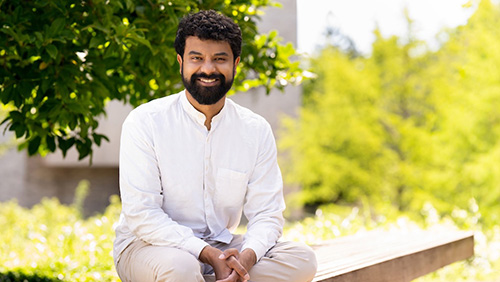
Bhattacharjee focuses on designing computer systems that harness the efficiency of emerging hardware without sacrificing ease of programmability for software developers. His research has influenced the hardware and operating systems that make up modern data centers and AI infrastructure.
Computing systems are built in layers, Bhattacharjee said, making it possible for engineers to specialize in one area of the computing stack without understanding in depth how every other component is built. Working on an operating system does not require an engineer to know how a computer chip works internally, for example. Nevertheless, software and hardware must always work in tandem.
“My interest is in making sure that programmers can continue to get the benefits of all of the amazing hardware that's being built without asking the programmer to have to know too much about the hardware,” Bhattacharjee said.
More recently, he has applied this expertise to building tiny computing devices that are implanted in the brain. These brain-computer interfaces, critical to basic neuroscience research, are increasingly being used to develop therapies for neurological disorders like stroke, Parkinson’s and epilepsy.
A central insight of Bhattacharjee’s work is that while specialized hardware is more efficient at some tasks, if it is overly specialized it can become rigid. Bhattacharjee has explored this research question in the context of managing computer memory and designing hardware to translate virtual memory to physical memory.
Bhattacharjee found that building efficient support for general-purpose use yielded a more adaptable system without sacrificing efficiency. “If the virtual memory layer that you add into the GPU is over-optimized and over-indexed for efficiency, tomorrow if the programmer changes the workload, the GPU won't be able to adapt to it,” Bhattacharjee said.
In 2017, while at Rutgers, Bhattacharjee spent a year as a C.V. Starr Visiting Fellow at the Princeton Neuroscience Institute. “I hung out there for a year on my sabbatical and just talked to people and took courses,” he said. He was interested in exploring ways to use his computing expertise to help scientists understand the brain.
His work with Jonathan Cohen, then co-director of the Princeton Neuroscience Institute, inspired him to pair his interest in creating more efficient servers with building neurotechnology. Brain-computer interfaces are a unique computing challenge, Bhattacharjee said, because they must live in the brain and collect large amounts of data while using limited power.
Much like servers, brain-computer interfaces require specialized hardware, he said, but that hardware also needs to be able to adapt.
“In the same way that it was clear that data center hardware would stand to gain from leaving a little bit of flexibility, it was also clear that you needed some flexibility in brain-computer interfaces,” said Bhattacharjee. Not enough is known yet about the brain, he added, that you can simply build a piece of hardware and move on.
Bhattacharjee has always enjoyed working across disciplines. He decided to pursue a doctorate in electrical engineering at Princeton because he could study a wide variety of topics — everything from semiconductor physics to optics to information theory and communications — but the department was small enough that he wouldn’t get lost. “I picked Princeton because of its size,” he said.
In his first year, he ran into Margaret Martonosi, now the William M. Addy ’82 University Professor in computer science, in the lounge getting coffee. At the time, Bhattacharjee said, her group was working on ZebraNet, a network of wireless devices built to track zebras in Kenya, and also branching into quantum computing. “I was curious about how she did that,” Bhattacharjee said. She would go on to become his adviser.
As Martonosi’s student, Bhattacharjee felt like he was given the space to own his research agenda and pursue his interests. “Margaret managed to figure out how to give people an environment where they could pick their path, but she also has very high standards,” he said. “In her group you could really become an expert in the thing that you cared about.”
Bhattacharjee also took formative courses with Kai Li and Doug Clark that sparked his interest in working across hardware and software layers. “Kai Li’s course on operating systems was the most influential technical course I have ever taken,” Bhattacharjee said. “It shaped my research taste and the way I approach technical problems.”
Bhattacharjee’s work has been recognized by the 2023 Association of Computing Machinery SIGARCH Maurice Wilkes Award, the computer architecture community’s highest distinction for a mid-career researcher. He received a National Science Foundation CAREER Award in 2013. He is the co-author of a 2017 textbook, “Architectural and Operating System Support for Virtual Memory,” with NVIDIA scientist Daniel Lustig. He has also been recognized for his outstanding teaching and mentorship at Yale, where he received both the Ackerman Prize and the Dylan Hixon ’88 Prize. Bhattacharjee earned his Ph.D. in electrical engineering from Princeton and a B.Eng. from McGill University.