By Colleen B. Donnelly and Tracy Meyer for the Princeton Graduate School
Sayash Kapoor has been named a Porter Ogden Jacobus Fellow, Princeton’s top distinction for graduate students.
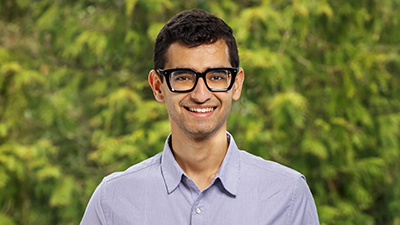
Kapoor is one of four graduate students to receive this honor. Other awardees this year are historian Philip Decker, mathematician Victor Geadah and literary scholar Eliana Rozinov. The Jacobus Fellows will be honored at Alumni Day ceremonies on Saturday, Feb. 21.
Established in 1905, just five years after the Graduate School was founded in 1900, the Jacobus fellowship is Princeton’s most prestigious fellowship. Jacobus Fellowships are awarded to one Ph.D. student in each of the four divisions — humanities, social sciences, natural sciences, and engineering — whose work demonstrates the highest scholarly excellence. The Jacobus Fellowship supports a student’s final year of study at Princeton.
“Throughout this 125th anniversary year of the Princeton Graduate School, we have been reflecting on the transformational impact of Princeton graduate education on our students, the University and the world,” said Rodney Priestley, dean of the Graduate School. “This year’s Jacobus Fellows exemplify that legacy. Their research topics range from how we can build trustworthy, accountable AI amid rapid adoption, to using mathematical modeling to examine how the brain makes decisions, to revisiting Freud through contemporary feminist insight, to illuminating a previously overlooked dimension of a pivotal moment in European history. What unites them is rigor, imagination and a commitment to scholarship with impact far beyond their fields.”
A computer scientist by training, Kapoor worked as a software engineer at Facebook before coming to Princeton in 2021. He’s a fifth-year Ph.D. candidate in computer science at Princeton’s Center for Information Technology Policy, and he earned his bachelor of technology in computer science from the Indian Institute of Technology Kanpur.
The core of Kapoor’s dissertation, “AI’s Impact on Science and Society,” is improving rigor in evaluations of artificial intelligence. “Imagine a world where cars were only tested by their manufacturers. That’s the world we’re in today with AI — it’s primarily AI developers that grade their own homework,” said his adviser, Arvind Narayanan, professor of computer science. “Sayash is one of the leading people in the world trying to change that. He’s developing the science of AI evaluation.”
Kapoor’s work has revealed that in the rush to adopt AI and machine learning, many researchers are using these tools erroneously in their scholarly papers. The errors can be extremely subtle — in one case, he found a mistake in a single parameter in 10,000 lines of code. Yet the consequences can be devastating.
“Unfortunately, it’s leading to a false scientific consensus across different fields, from political science to medicine,” Kapoor said. “In some cases, the majority of papers that had adopted AI and machine learning were actually flawed.” He found similar problems in real-world deployment of AI systems. “In tools ranging from education to criminal justice to finance to hiring algorithms, these errors remained pervasive, and these failures could influence a person’s entire life trajectory,” Kapoor said.
To address this, Kapoor has brought together scientists from many disciplines to improve best practices for using AI in research. He is also building a framework that third parties can use to evaluate new claims about AI agents in ways that are transparent, scientifically rigorous, and inform public debate on these topics. “The work I do is driven by the belief that the public can and should have a voice in how these tools are deployed,” Kapoor said.
He is also moving the needle on public policy in AI, engaging with policymakers through public testimonies, offering feedback on draft legislation, and providing neutral, nonpartisan, technical expertise that’s often missing from conversations about AI. “His work is, in many cases, essential reading for policymakers on the topic of AI,” Narayanan said.
Kapoor is a senior fellow at Mozilla and was a Laurance S. Rockefeller Fellow in the Princeton University Center for Human Values. Named one of TIME’s 100 most influential people in AI, he has been cited over 3,000 times, and is coauthor, with Narayanan, of “AI Snake Oil,” one of Nature’s 10 best books of 2024.