By Liz Fuller-Wright
The Wiley Foundation announced today that the 24th annual Wiley Prize in Biomedical Sciences has been awarded to Princeton’s Sebastian Seung and Mala Murthy, along with John White and Gerald Rubin, “for reconstructing and interpreting connectomes, the wiring diagrams that anatomically interconnect nerve cells and thereby drive information processing in nervous systems.”
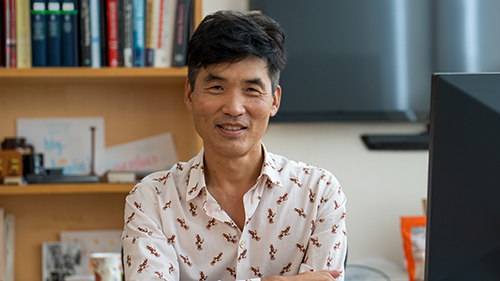
“Understanding a connectome is essential to understanding the nature and logic of a nervous system and hence how it functions to respond to stimuli in the environment and control behavior and other physiological outputs, how it develops and can be modified with experience and age, and how it might dysfunction in disease,” said H. Robert Horvitz, a 2002 Nobel Prize laureate and a member of the Wiley Prize awards jury, in the award announcement.
Seung, the Anthony B. Evnin ’62 Professor in Neuroscience and professor of computer science, is the author of the 2012 book “Connectome: How the Brain’s Wiring Makes Us Who We Are,” which explained neuroscience for nonexperts and introduced the public to the concept of the connectome, the set of connections among the brain’s neurons.
“In the beginning, connectomics was quite controversial, but this award suggests that it’s becoming mainstream,” said Seung. “I read about scientific revolutions when I was a youngster, but I didn’t realize I would participate in two — one in deep learning and one in connectomics. A scientific revolution is when everybody first thinks an idea is wrong, and then later on, everybody thinks it’s right. That’s rare in science, but it happens — and now these two revolutions are intertwined.”
Murthy is the Karol and Marnie Marcin ’96 Professor of Neuroscience and Director of the Princeton Neuroscience Institute. She combined her deep expertise in fruit fly neuroscience with Seung’s expertise in neural networks and neuronal mapping, leading to their groundbreaking 2024 announcement of the first complete brain map of an adult fruit fly, in collaboration with the international FlyWire community.
“I feel very humbled and honored by this prize,” said Murthy. “The big surprise to me is how quickly this achievement has been recognized. Usually it takes decades for something you’ve worked on to percolate through the field, for people to appreciate the utility of it. I think it speaks to how useful the connectome has been to fly research — not only to understand flies, but because solving how any brain processes sensory information, makes decisions, learns something, executes actions, is important. It’s clear now how a map of the brain can lead to fundamental discoveries about how brains work. And I think the fly field, which I’m very proud to be a part of, has made that very, very clear.”
Murthy and Seung share the Wiley Prize with White, an emeritus professor of anatomy and molecular biology at the University of Wisconsin-Madison, and Rubin, a senior group leader at the Howard Hughes Medical Institute’s Janelia Research Campus. White reconstructed the C. elegans nervous system in the 1970s and 80s, successfully mapping the simple worm’s 302 neurons over the course of nearly 20 years. Rubin directed HHMI Janelia’s FlyEM project, which competed with Princeton’s FlyWire to map an adult fruit fly brain, with its almost 140,000 neurons and tens of millions of synapses connecting them.
“By awarding this to all four of us, the prize recognizes the long history of this work, starting with the worm in the ’70s and ’80s, and it reminds us that this prize really is about the efforts of a lot of people over a long period of time,” said Seung. “The second thing is, it reminds you that at the beginning of an idea, people might pooh-pooh it and say that it’s the wrong idea, and it could take a long time to prove that it’s actually worth something.”
Murthy and Seung have continued to push the science of connectomics forward. In April 2025, Seung and the MICrONS consortium announced that they had reconstructed the connectome of a 1-millimeter cube of a mouse’s visual cortex, with almost 76,000 neurons connected by half a billion synapses. The BANC-FlyWire Consortium recently released a connectome of the entire central nervous system of a fly.
Since 2002, the Wiley Prize in Biomedical Sciences has honored researchers who “have opened new fields of research or have advanced concepts in a particular biomedical discipline.” Each year, between one and four scientists are honored. Two other Princeton professors have received the award: Bonnie Bassler in 2009 and Cliff Brangwynne in 2020. Of the 55 Wiley Prize winners over the past 24 years, 13 have gone on to win the Nobel Prize in physiology or medicine, and five have won the Nobel Prize in chemistry.
Murthy, Seung and the other two winners will receive their prizes at the annual Wiley Prize lecture on April 10.