Princeton engineering faculty members Adji Bousso Dieng and Aleksandra Korolova have been named to a U.N. panel that will examine the risks, opportunities and impacts of artificial intelligence.
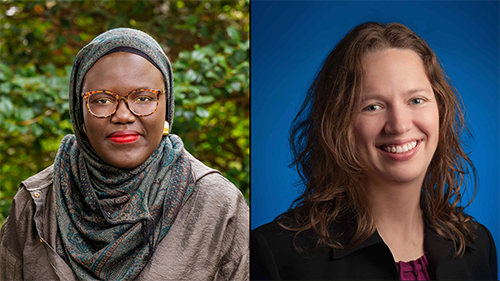
The United Nations Independent International Scientific Panel on Artificial Intelligence, created in August 2025, is the “first global scientific body dedicated entirely to artificial intelligence,” according to the U.N. Composed of 40 international experts, the panel will convene periodically over the next three years to produce reports on the technology.
“The Scientific Panel on AI will serve as a crucial bridge between cutting-edge AI research and policymaking,” according to a U.N. statement. “By providing rigorous, independent scientific assessments, it will help the international community to anticipate emerging challenges and make informed decisions about how we govern this transformative technology.” The panel will present its annual report each year at the United Nations Global Dialogue on AI Governance.
Dieng and Korolova were selected from over 2,600 applicants and nominated by U.N. Secretary-General António Guterres. On February 12 their appointments were confirmed by the U.N. General Assembly.
Dieng, an assistant professor of computer science, does research at the intersection between artificial intelligence and the natural sciences. Her lab, Vertaix, has developed a tool called the “Vendi Score” to evaluate the diversity of data sets and model outputs, which is critical for developing robust machine learning tools and for accelerating scientific discovery. Her lab has recently done research that uses the Vendi Score to detect emerging variants of viral diseases like COVID-19 before they are formally identified.
Korolova, an assistant professor of computer science and public affairs, studies societal impacts of AI, and develops and deploys algorithms and technologies that enable data-driven innovations while preserving privacy, fairness, and robustness. She also designs and performs algorithm and AI audits.
Dieng joined the Princeton faculty in 2021. Her work has also been recognized with a Prix Galien Africa Special Prize, a 2022 Schmidt Sciences AI2050 Early Career Fellowship and the 2022 Annie T. Randall Innovator Award from the American Statistical Association. She was a research scientist at Google DeepMind from 2020-2025. She holds a Diplôme d’Ingénieur from Télécom Paris, a master’s degree from Cornell University and a Ph.D. from Columbia University. At Princeton she is affiliated with the Department of Chemical and Biological Engineering, the Princeton Materials Institute, Princeton Precision Health, the Princeton Quantum Initiative, the Andlinger Center for Energy and the Environment, and the High Meadows Environmental Institute.
Korolova joined the Princeton faculty in 2022. She holds a joint appointment in the School of Public and International Affairs and is associated faculty in the Center for Information Technology Policy. Prior to Princeton she was an assistant professor of computer science at the University of Southern California, a research scientist at Google and a privacy adviser at Snap, Inc. Her work has been recognized by an Presidential Early Career Award for Scientists and Engineers, a Sloan Research Fellowship and an NSF CAREER Award.
Her work on RAPPOR, the first commercial deployment of differential privacy, received the CCS 2024 Test-of-Time Award. Her research on discrimination in ad delivery has received the 2019 CSCW Honorable Mention Award and Recognition of Contribution to Diversity and Inclusion and was a winner of the 2025 FAccT Best Paper Award. She completed a bachelor’s degree at the Massachusetts Institute of Technology and a doctoral degree at Stanford University.