 WordNet
 groups words into sets of synonyms called synsets. For example, { AND circuit, AND gate } is a synset representing a logical gate that fires only when all of its inputs fire. WordNet also describes semantic relationships between synsets. One such relationship is the is-a relationship, which connects a hyponym (more specific synset) to a hypernym (more general synset). For example, the synset { gate, logic gate } is a hypernym of { AND circuit, AND gate } because an AND gate is a kind of logic gate.
The WordNet digraph. Your first task is to build the WordNet digraph: each vertex v is an integer that represents a synset, and each directed edge v→w represents that w is a hypernym of v. The WordNet digraph is a rooted DAG: it is acyclic and has one vertex—the root—that is an ancestor of every other vertex. However, it is not necessarily a tree because a synset can have more than one hypernym. Here is a small subgraph of the WordNet digraph:

The WordNet input file formats. We now describe the two data files that you will use to create the WordNet digraph. The files are in comma-separated values (CSV) format: each line contains a sequence of fields, separated by commas.
synsets.txt
contains all noun synsets in WordNet, one per line.
Line i of the file (counting from 0) contains the information for synset i.
The first field is the synset id, which is always the integer i;
the second field is the synonym set (or synset); and the
third field is its dictionary definition (or gloss), which is not relevant
to this assignment (and so you can ignore it).

AND_circuit, AND_gate }
has an id number of 36 and its gloss is
a circuit in a computer that fires only when all of its inputs fire.
The individual nouns that constitute a synset are separated by spaces.
If a noun contains more than one word, the underscore character connects
the words (and not the space character).
hypernyms.txt
contains the hypernym relationships.
Line i of the file (counting from 0) contains the hypernyms of synset i.
The first field is the synset id, which is always the integer i;
subsequent fields are the id numbers of the synset’s hypernyms.

AND_circuit AND_gate)
has 43273 (gate logic_gate) as its only hypernym. Line 34 means that
synset 34 (AIDS acquired_immune_deficiency_syndrome) has two hypernyms:
48504 (immunodeficiency) and 49019 (infectious_disease).
WordNet data type.
Implement an immutable data type WordNet with the following API:
public class WordNet {

   // constructor takes the name of the two input files
   public WordNet(String synsets, String hypernyms)

   // the set of all WordNet nouns
   public Iterable<String> nouns()

   // is the word a WordNet noun?
   public boolean isNoun(String word)

   // a synset (second field in synsets.txt entries) that is a shortest common ancestor
   // of noun1 and noun2 (defined below)
   public String sca(String noun1, String noun2)

   // distance between noun1 and noun2 (defined below)
   public int distance(String noun1, String noun2)

   // unit testing (required)
   public static void main(String[] args)

}
(Note that the implementations of distance() and sca() rely on
data types described later.)
Corner cases.
Throw an IllegalArgumentException if
null.
distance() or sca()
is not a WordNet noun.
Unit testing. Your main() method must call directly every public constructor and method to help verify that they
work as prescribed (e.g., by printing results to standard output).
Testing suggestions are provided in the Checklist.
Performance requirements. Your implementation must achieve the following performance requirements. In the requirements below, assume that the number of characters in a noun or synset is \(O(1)\).
isNoun() must run in time logarithmic (or better) in
the number of nouns.
distance() and sca() must make exactly one call
to the lengthSubset() and ancestorSubset() methods in ShortestCommonAncestor,
respectively.
Shortest common ancestor. An ancestral path between two vertices v and w in a rooted DAG is a directed path from v to a common ancestor x, together with a directed path from w to the same ancestor x. A shortest ancestral path is an ancestral path of minimum total length. We refer to the common ancestor in a shortest ancestral path as a shortest common ancestor. Note that a shortest common ancestor always exists because the root is an ancestor of every vertex. Note also that an ancestral path is a path, but not a directed path.

We generalize the notion of shortest common ancestor to subsets of vertices.
A shortest ancestral path of two subsets of vertices A and B
is a shortest ancestral path among all pairs of vertices v and w, with v
in A and w in B.
As an example, the following figure (digraph25.txt) identifies
several (but not all) ancestral paths between the red and blue vertices, including the shortest one.

ShortestCommonAncestor with the following API:
public class ShortestCommonAncestor {

   // constructor takes a rooted DAG as argument
   public ShortestCommonAncestor(Digraph G)

   // length of shortest ancestral path between v and w
   public int length(int v, int w)

   // a shortest common ancestor of vertices v and w
   public int ancestor(int v, int w)

   // length of shortest ancestral path of vertex subsets A and B
   public int lengthSubset(Iterable<Integer> subsetA, Iterable<Integer> subsetB)

   // a shortest common ancestor of vertex subsets A and B
   public int ancestorSubset(Iterable<Integer> subsetA, Iterable<Integer> subsetB)

   // unit testing (required)
   public static void main(String[] args)

}
Corner cases.
Throw an IllegalArgumentException in the following cases:
null.
Iterable) is outside its prescribed range.
null item.
Basic performance requirements. Your implementation must achieve the following worst-case performance requirements, where E and V are the number of edges and vertices in the digraph, respectively.
Additional performance requirements (for extra credit).
In addition, the methods
length(), lengthSubset(), ancestor(), and
ancestorSubset() must take time proportional to
the number of vertices and edges reachable from the argument vertices (or better).
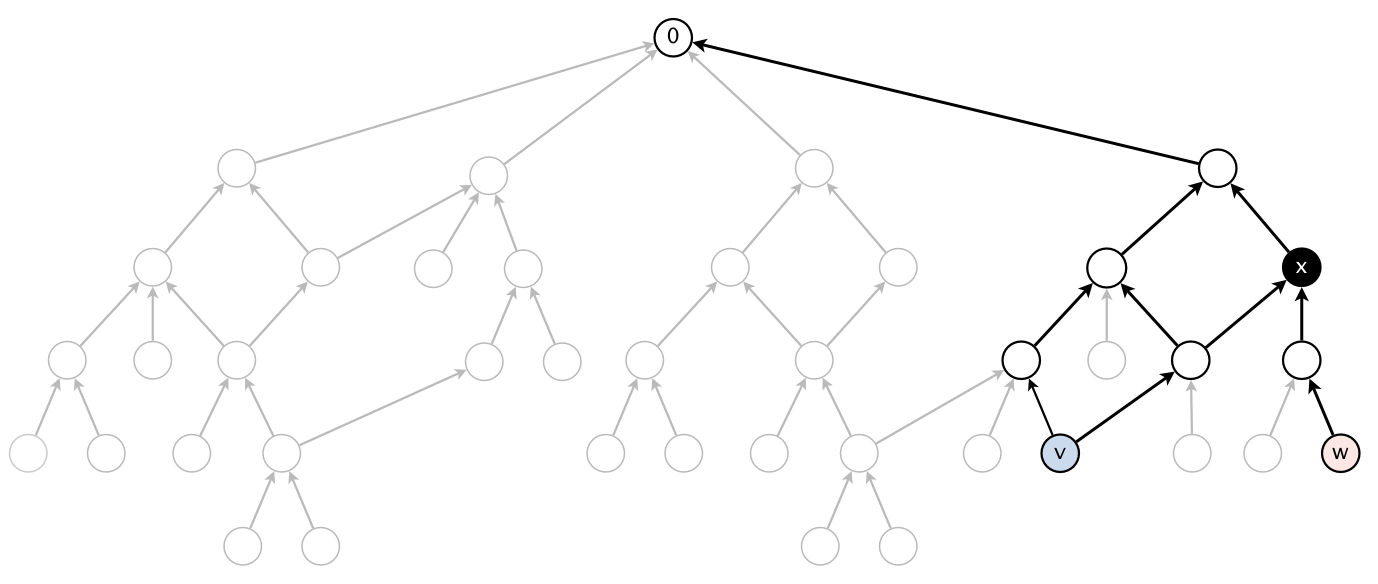
For example, to compute the shortest common ancestor of v and w
in the following digraph, your algorithm can examine only the highlighted vertices and edges;
it cannot initialize any vertex-indexed arrays.
Unit testing. Your main() method must call directly every public constructor and method to help verify that they
work as prescribed (e.g., by printing results to standard output). Test client suggestions are provided in the Checklist.
Measuring the semantic relatedness of two nouns. Semantic relatedness refers to the degree to which two concepts are related. Measuring semantic relatedness is a challenging problem. For example, most people consider George W. Bush and John F. Kennedy (two U.S. presidents) to be more closely related than George W. Bush and chimpanzee (two primates). It might not be clear whether George W. Bush and Eric Arthur Blair are more related than two arbitrary people. However, both George W. Bush and Eric Arthur Blair (a.k.a. George Orwell) are famous communicators and, therefore, closely related.
We define the semantic relatedness of two WordNet nouns x and y as follows:
This is the notion of distance that you will use to implement the
distance() and sca() methods in the WordNet data type.

Outcast detection. Given a list of WordNet nouns x1, x2, ..., xn, which noun is the least related to the others? To identify an outcast, compute the sum of the distances between each noun and every other one:
di = distance(xi, x1) + distance(xi, x2) + ... + distance(xi, xn)and return a noun xt for which dt is maximum. Note that distance(xi, xi) = 0, so it will not contribute to the sum.
Implement an immutable data type Outcast with the following API:
public class Outcast {

   // constructor takes a WordNet object
   public Outcast(WordNet wordnet)

   // given an array of WordNet nouns, return an outcast
   public String outcast(String[] nouns)

   // test client (see below)
   public static void main(String[] args)

}
Corner cases.
Assume that the argument to outcast() contains only valid WordNet
nouns and that it contains at least two such nouns.
Unit testing.
The following Outcast test client takes from the command line the
name of a synset file, the name of a hypernym file, followed by the
names of outcast files, and prints an outcast in each file:
public static void main(String[] args) {
    WordNet wordnet = new WordNet(args[0], args[1]);
    Outcast outcast = new Outcast(wordnet);
    for (int t = 2; t < args.length; t++) {
        In in = new In(args[t]);
        String[] nouns = in.readAllStrings();
        StdOut.println(args[t] + ": " + outcast.outcast(nouns));
    }
}
Here is a sample execution:
~/Desktop/wordnet> more outcast5.txt
horse zebra cat bear table

~/Desktop/wordnet> more outcast8.txt
water soda bed orange_juice milk apple_juice tea coffee

~/Desktop/wordnet> more outcast11.txt
apple pear peach banana lime lemon blueberry strawberry mango watermelon potato

~/Desktop/wordnet> java-algs4 Outcast synsets.txt hypernyms.txt outcast5.txt outcast8.txt outcast11.txt
outcast5.txt: table
outcast8.txt: bed
outcast11.txt: potato
Submission.
Submit WordNet.java, ShortestCommonAncestor.java,
and Outcast.java.
Also submit any other supporting
files (excluding those in algs4.jar).
You may not call any library functions other than those in
java.lang, java.util, and algs4.jar.
Finally, submit
acknowledgments.txt.
Grading.
file points WordNet.java12 ShortestCommonAncestor.java20 Outcast.java8 40
Extra credit: You can earn 3 bonus points for meeting the additional
performance requirements in ShortestCommonAncestor.
Note that assignment scores are capped at 40.