


COS 341, September 29, 1997Handout Number 5
Math Casino
Let  . Roulettes in the Math Casino have the following rule.
For each run, a random integer n,
. Roulettes in the Math Casino have the following rule.
For each run, a random integer n,  is uniformly
generated. If
is uniformly
generated. If  divides n, you win
$5; otherwise, the $1 bet you place is forfeited. Should you
play the game? One way to make a rational decision is to
calculate the probability p of winning a game, and play the
game if and only if
divides n, you win
$5; otherwise, the $1 bet you place is forfeited. Should you
play the game? One way to make a rational decision is to
calculate the probability p of winning a game, and play the
game if and only if  . How can we compute p?
By definition p=m/N, where m is the number of integers  that satisfy divides n''.
Let
that satisfy divides n''.
Let  be the set of integers n satisfying
  (i.e.,
 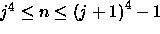 )
and j dividing n''. Clearly,
)
and j dividing n''. Clearly,

where the term 1 comes from the  contribution.
Let  . Starting at
  , every j-th integer in the
range satisfies j dividing n.
Hence,
, every j-th integer in the
range satisfies j dividing n.
Hence,
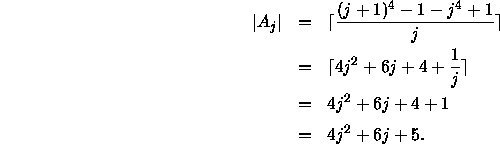
This shows

It remains to evaluate 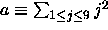 . Using
the equality
. Using
the equality 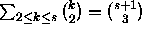 ,
we have
,
we have
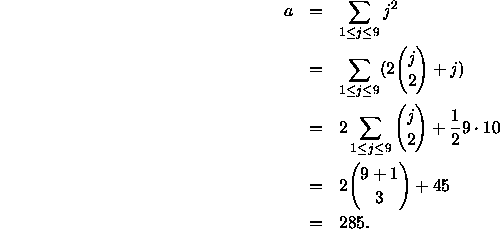
From (1) we then have

Hence p=m/N=0.1456 <1/5, and you shouldn't play this game.
This solves the Math Casino Problem.