


COS 341, September 22, 1997Handout Number 3
The Dating Problem and the Lottery Problem
Probability
A probability space  is
a pair (A, p) where A is a finite set, and
is
a pair (A, p) where A is a finite set, and
 is a function such that
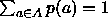 . An event T is
a subset of A. The probability for T
to occur is defined as
. An event T is
a subset of A. The probability for T
to occur is defined as  .
.
The notion of probability space is used to model a random process, in which A is the set of all possible configurations, and configuration a is the realized configuration with probability p(a). We restrict A to be a finite set for simplicity (in general A could be infinite). The notion of event models a boolean predicate that is of interest.
The Dating Problem
In the Dating Problem with parameters n,k, the probability
space is  , where A is the set of
all permutations of
, where A is the set of
all permutations of  , and
p(a)=1/|A| for all
, and
p(a)=1/|A| for all  . It is easy to
see that a permutation
. It is easy to
see that a permutation  is
in T if and only if the following conditions are satisfied:
is
in T if and only if the following conditions are satisfied:
C1:  ;
C2: Let
;
C2: Let  where
where  , then
the minimum of
, then
the minimum of 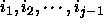 is
among the first k of these numbers.
is
among the first k of these numbers.
Let  denote the set of all a's satisfying C1, C2 with j
being the j in C2. Then T is the disjoint union of such .
By the Addition Principle, we have
denote the set of all a's satisfying C1, C2 with j
being the j in C2. Then T is the disjoint union of such .
By the Addition Principle, we have

We assert that for each ,

To see this, note that is itself the disjoint union of
 , where
  consists
of
consists
of  with the minimum of
 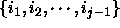 occurring at
  . Now each element of can be
specified by first choosing an (n-j)-permuation of
. Now each element of can be
specified by first choosing an (n-j)-permuation of
 (to fix
 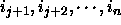 ),
and then a (j-2)-permutation of the set
),
and then a (j-2)-permutation of the set
 minus its minimum element (to fix
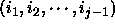 ). Therefore, by the
Multiplication Principle, we have
). Therefore, by the
Multiplication Principle, we have
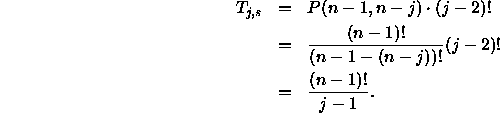
This proves (2). (Alternatively, one can argue that it is
equally likely for a random a with to have the
minimum of to occur at s for any
 . Since there are (n-1)! a's with
,
the number of such permutations with the minimum occurring in
the first k locations is equal to
. Since there are (n-1)! a's with
,
the number of such permutations with the minimum occurring in
the first k locations is equal to  .)
.)
It follows from (1) and (2) that

Since |A|=n!, this means

This completes the analysis of the probability of success under the strategy used with parameters n,k.
For example, if n=8, k=4,

Lottery
We considered in class a simplified version of California Lottery.
Let 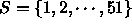 . The probability space is ,
where A is the set of all 6-combinations of S, and p is
uniform on A (i.e., p(a)=1/|A| for all ).
Assume that you have picked a particular 6-combination
. The probability space is ,
where A is the set of all 6-combinations of S, and p is
uniform on A (i.e., p(a)=1/|A| for all ).
Assume that you have picked a particular 6-combination
 . When the lottery drawing is to be
done, the event T corresponding to your winning 5 dollars is
the set of all 6-combinations that intersects
. When the lottery drawing is to be
done, the event T corresponding to your winning 5 dollars is
the set of all 6-combinations that intersects
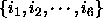 in exactly three elements.
(If the intersection is larger than 3, you win more than 5
dollars.) What is p(T)?
in exactly three elements.
(If the intersection is larger than 3, you win more than 5
dollars.) What is p(T)?
Clearly, p(T)=|T|/|A|. As  , we only need to calculate |T|. For each subset
  of size 3, let
  be the set of all 6-combinations of S
that have J as their intersection with I. Then by the Addition
Principle,
be the set of all 6-combinations of S
that have J as their intersection with I. Then by the Addition
Principle,

As each 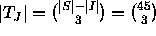 , we have
 . Thus,
