


COS 341, December 3, 1997Handout Number 22
Diameters, Guess and Verify
Diameters
Let G be a graph on n vertices  .
Let d(i,j) denote the distance between vertices
i,j in G (ie, the length of the shortest
path from i to j in G).
By convention, d(i,i)=0 for all i.
It is easy to see that the triangle
inequalities are satisfied, ie,
.
Let d(i,j) denote the distance between vertices
i,j in G (ie, the length of the shortest
path from i to j in G).
By convention, d(i,i)=0 for all i.
It is easy to see that the triangle
inequalities are satisfied, ie,
 for all i,j,k.
The diameter
for all i,j,k.
The diameter  is defined as
 . Clearly,
  .
.
Given an input G, we will give an
algorithm that determines in
time 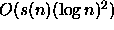 where
s(n) is the time needed to compute
the boolean matrix product of two
where
s(n) is the time needed to compute
the boolean matrix product of two
 boolean matrices.
Let  denote the boolean matrix
such that
denote the boolean matrix
such that  iff
either i=j or
iff
either i=j or  is an
edge in G; all other entries are
0. Thus, iff
is an
edge in G; all other entries are
0. Thus, iff
 . The following
generalization of the above statement
is the key observation needed to
develop our algorithm.
. The following
generalization of the above statement
is the key observation needed to
develop our algorithm.
Lemma For all integers
 ,
,  iff
iff
 .
.
Proof We prove by induction on t. The base case t=1 is true by an observation made in the paragraph before the Lemmma. For the inductive step, let t>1, and assume that the Lemma is true for all lesser values.
Observe that

We now establish the case for t.
First one direction. Assume .
By (1) there exists a vertex k such
that  .
By the induction hypothesis applied to
t-1 and 1, this vertex k satisfies
.
By the induction hypothesis applied to
t-1 and 1, this vertex k satisfies
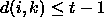 and
and  .
This implies then
.
This implies then  .
.
Second, in the opposite direction,
assume that .
Let k be a vertex such that
and ;
we can take k to be j if i=j,
and otherwise the last vertex
before reaching j on the
shortest path from i to j.
By the induction hypothesis,
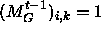 and
and  .
It follows then from (1)
that .
This completes the inductive step
in the proof of the Lemma.
.
It follows then from (1)
that .
This completes the inductive step
in the proof of the Lemma.
Let D denote the boolean matrix with
all its entries equal to 1. The
Lemma implies that  for
all
for
all  . It also implies that
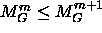 (entrywise) for all m.
Thus, to determine
, it suffices to find the smallest
t such that . Recall that
and thus the range of
this t is between 1 and n-1.
(entrywise) for all m.
Thus, to determine
, it suffices to find the smallest
t such that . Recall that
and thus the range of
this t is between 1 and n-1.
To do this, first compute all the
powers  ,
where
,
where  is the first time the
matrix power
is the first time the
matrix power  becomes D.
The running time spent in this round
is
becomes D.
The running time spent in this round
is  .
We have now determined that
is in the range
.
We have now determined that
is in the range 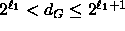 . The range is
thus halved in this round.
. The range is
thus halved in this round.
In the second round, we compute
all the powers  ,
where
,
where  is the first time the
matrix power
is the first time the
matrix power  becomes D.
The running time spent in this round
is
becomes D.
The running time spent in this round
is  .
We have now determined that
is in the range
.
We have now determined that
is in the range
 .
The search range is thus halved in
this round.
.
The search range is thus halved in
this round.
We can similarly carry out the
3rd round, 4th round, until
the range is reduced to zero.
The total running time is
 which is
 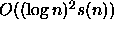 ,
since
,
since  and each
  .
.
We remark that in fact 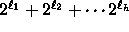 is the
binary representation of the integer
is the
binary representation of the integer
 .
.
In Homework Set 8, you will be asked
to modify the above search process
and improve the running time
to  .
.
Guess and Verify
In this approach, when confronted with a recurrence relation, we guess an upper bound (or lower bound) expression for the function. Then verify by induction. The following example comes from the analysis of the running time T(n) of a backtracking algorithm for listing all the maximal independent sets of n-vertex input graphs:

We prove by induction that, for all  ,
,

where  are the Fibonacci numbers.
Before proceeding with the proof, we compute
the values of T(n) and for  . It turns out that the T(n)'s
are 1,1,4,8,16,29, 51; the
. It turns out that the T(n)'s
are 1,1,4,8,16,29, 51; the
 are 1,1,2,3,5,8,13.
For the base n=0, 1, (3) is clearly true since T(0)=T(1)=1 by definition. For the inductive step, let n>1 and assume that (3) is valid for all lesser values. We establish (3) for n.
If  , then (3) is true by
using the values we have computed for
, then (3) is true by
using the values we have computed for
 .
We can thus assume that n > 6.
Using the recurrence (2) and the induction
hypothesis (3) for n-1 and n-2,
we have
.
We can thus assume that n > 6.
Using the recurrence (2) and the induction
hypothesis (3) for n-1 and n-2,
we have

This completes the inductive proof of (3).
How did we come to the lucky guess (3)?
Here is the rationale. First observe
that, if the +n term is missing in the
recurrence (2), then would be the
solution. Since +n is such a small
additional term compared with the
 terms, a reasonable
guess is
terms, a reasonable
guess is

for some constant, say, c=10. However, if you try to verify (4) by induction using the recurrence (2), you cannot carry out the inductive step, ie, you get

which does not complete the inductive step.
What we lacked is an additional term in T(n) such that they can absorb the +n term. A natural choice is to guess

However, the inductive step still falls a little short, since we get only

Thus, we want to make the additional term a little more negative. Also, we need to choose c carefully so that the negative new term does not kill the validity of the base case.
Let us make the guess in the general form

for some c,d >1, and see what parameters can make the inductive proof work.
Take the inductive step first. We have

To make the inductive step work, we need
the condition  , ie,
, ie,

This means that, if d>1 is chosen, then
the inductive step can be carried out
if 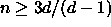 .
.
But the inductive step (and the base case n=0,1) needs to be done when n < 3d/(d-1). This can be accomplished by brute force, that is, by choosing the parameter c to be large enough. In fact, all we need is that equation (5) be satisfied for all n < 3d/(d-1). Equivalently, we need

If d=2 (hence 3d/(d-1)=6), it is sufficient to choose c to be at least as big as

which is less than 5.