


COS 341, October 15, 1997Handout Number 11
Solving Recurrence with Generating Functions
The first problem is to solve the recurrence
relation system  , and
, and  for
for  .
.
Let  . Multiply both
side of the recurrence by
. Multiply both
side of the recurrence by  and sum over .
This gives
and sum over .
This gives

Note that
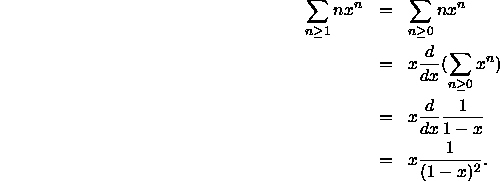
Thus, in term of A(x), we obtain

Rearranging terms, we get

Hence,

We can now get  by expanding A(x) as a series

This gives, for all  ,
,
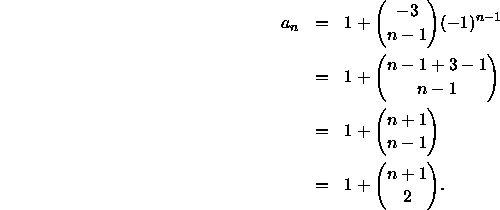
This is the same answer as we obtained earlier by different means.
The next problem for solution is the Rabbit Island problem. Before studying it, let us note the following identity, valid for any distinct numbers b and c:

It can be directly verified by taking common denominators
of the terms on the right-hand-side, and
simplyfing the expression. A more systematic way to do
this is to solve the system of equations for
variables  ,
,

The solution satisfyies the equation

and gives

This is a special case of the partial fraction decomposition. You might find it challenging to extend the discussion to show that, if b,c,d are distinct,

with sosme appropriate choice of  .
.
In the Rabbit Island problem, we need to solve the
recurrence  , and
, and  for
for
 . Let .
As in the previous problem, let us multiply the
recurrence by
. Let .
As in the previous problem, let us multiply the
recurrence by  and sum over . This gives

In terms of A(x), we have
 . This leads to

It remains to expand A(x) into a power series, so that we can
identify .
Now note that
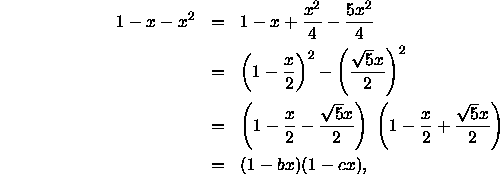
where 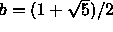 and
and 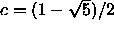 .
Using (1) and (2), we can expand A(x) as
.
Using (1) and (2), we can expand A(x) as
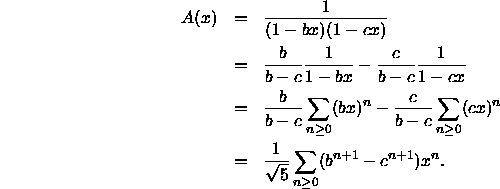
Thus, for all , we have

For n=0,1, this formula gives ,  , as was to be
expected.
, as was to be
expected.
The numbers are called Fibonacci numbers, and often
denoted by  .
Note that
.
Note that  and
and  .
Thus,
.
Thus,  is numerically a
very small number, while
is numerically a
very small number, while  is large. For reasonably large
n, say n>10, can be obtained by evaluating
is large. For reasonably large
n, say n>10, can be obtained by evaluating
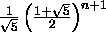 , and rounding it to
the closest integer.
, and rounding it to
the closest integer.
The third problem we tackle is the recurrence
 , , and
  for . The quantity is the number of ways to
parenthesize an expression
for . The quantity is the number of ways to
parenthesize an expression  .
.
Let  .
The recurrence relation gives
.
The recurrence relation gives
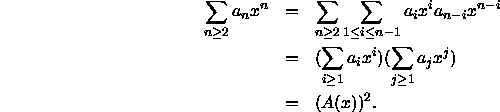
This means 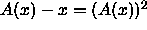 , and hence
  .
Solving the quadratic equation for A(x), we obtain
two possible solutions:
.
Solving the quadratic equation for A(x), we obtain
two possible solutions:
 and
and  . The
former solution can be discarded, since it would give
. The
former solution can be discarded, since it would give
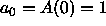 , which contradicts our assumption .
Thus,
, which contradicts our assumption .
Thus,
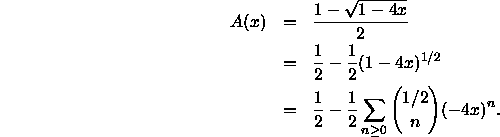
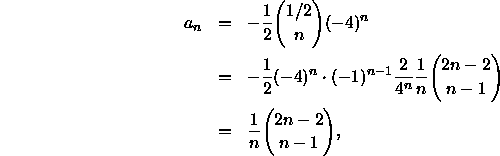
We infer from it , and for ,

Note that, for
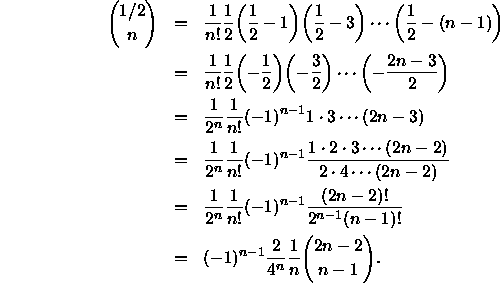
This leads to
for . The above formula also holds for n=1 since both
sides are equal to 1. (Recall 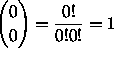 .)
The numbers are often called the Catalan numbers.
.)
The numbers are often called the Catalan numbers.