
|
|
Reassembling the Thera Frescoes:
Automated Digitization and Matching of Fragments
|
Summary
The archaeological site of Akrotiri on the island of Thera (modern-day
Santorini) has proven a treasure trove of information about Aegean
civilization and culture. Among its most valued artifacts are wall
paintings (frescoes), which have been preserved in the volcanic ash
since the seventeenth century BC. The frescoes, however, are typically
recovered in fragments of a few centimeters to a few tens of centimeters
in length, and reconstructing complete wall sections occupies a major
portion of the effort at Akrotiri.
We are engaged in a project to assist archaeologists and conservators by
digitizing excavated fragments and using computer algorithms to
automatically propose matches on the basis of 3D edge profile, color,
and other cues. An intuitive user interface will allow conservators to
see and evaluate matches on the basis of any or all of the above
criteria. We hope to greatly reduce the time that is currently spent
manually testing large numbers of fragments against each other in the
search for matches.
Our project has three major components:
- Acquisition.
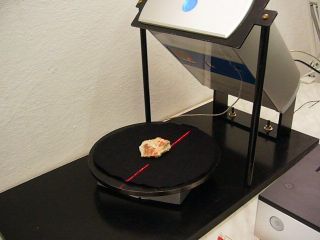
Beginning with commercially-available color and 3D scanners, we built
a hardware configuration for capturing the color texture of each
fragment, together with its thickness and 3D shape. We have written
custom software to control the scanners, ensuring that capture is easy
(may be performed by non-computer-experts) and fast (no more than a
few minutes per fragment). The captured data is automatically
processed into a final model, and a simple interface allows the user
to verify the result and quickly correct occasional errors. All
captured data is stored together with semantic information about the
fragment, as well as any annotations provided by archaeologists and
conservators.
The acquisition system and data processing algorithms are described in
our Siggraph 2008 paper,
"
A System for High-Volume Acquisition and Matching of Fresco Fragments:
Reassembling Theran Wall Paintings" (accompanying video).
|
|
Our 3-D scanner setup.
|
- Matching algorithms.
Building on recent research results, we are investigating a system for
computing candidate matches between fragments, and proposing them to the
user for verification. We will explore different cues for performing
this matching, including the 3D shape of edges, fragment thickness,
color and edges on the surface, any user-supplied annotations, and
arbitrary combinations of different cues.
We have started by developing a matcher based on the 3D edge
information, called the "ribbon matcher." Designed to mimic
a procedure used by the conservators to find and verify matches, the
ribbon matcher exhaustively tests every possible configuration of a
pair of fragments to find an optimal arrangement. On a modern PC, it
takes about two seconds to test a pair of fragments. We achieve this
performance by resampling each fragment edge in regular rows and
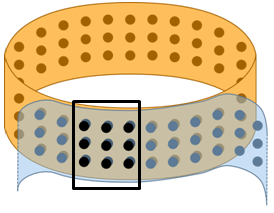
columns (a "ribbon"). Using these ribbons, we can
effectively roll one fragment around the other, updating the alignment
and associated error in constant time at each step. The process is
quite similar to a convolution, and is fully described in
our Siggraph
2008 paper and accompanying
video.
|
|
The ribbon matcher operates by sliding a window across a pair
of ribbons, incrementally updating the alignment and associated
error. The process is quite similar to searching for a matching
window in a pair of images.
|
- User interface.
We are developing a computer program that allows users to move fragments
or groups of fragments on the screen, easily evaluating the proposed
matches. The software keeps track of information associated with each
fragment, including excavation data, annotations, and the color and 3D
scans. In addition, there is data associated with each match, including
the quality of the match and any conservators' annotations. The
software will also include features such as revision control and support
for concurrency, allowing multiple users to work either simultaneously
or serially.
Results
- Real Fragments
As of August 2008 we have scanned 283 real fragments at Akrotiri
grouped into three test sets &emdash; red (134 fragments), white (105
fragments), and spiral (44 fragments). These fragments come from the
"spiral" wall painting, and were selected by the conservators for the
test. Each set contains a small number of known matches, but most
fragments do not match any others in the test set. The matches we
have found with out ribbon matcher (and which the conservators have
verified on the actual fragments) are shown below. The conservators
know of two matches which we have not found, however two of the three
white matches are "new," that is, the conservators were not aware of
these matches until we proposed them.
- Test Fresco
The conservators have also prepared a test fresco for us, in the style
of the ancient frescoes. They applied an earthquake to this fresco,
then mailed it to us. Although these fragments are not as old as the
real ones, the large umber of matches helps us test whether we can
effectively reconstruct an entire fresco. This fresco is also shown
below, with all the matches than we found marked with a colored line.
The different colors indicate different parameters to the ribbon
matcher, which are fully described
in our
paper (video).
- Images of the results are shown here.
Press, Publications and Links
- 'Virtual
archaeologist' reconnects fragments of an ancient civilization
Princeton University press release, August 2008
- A System for High-Volume Acquisition and Matching of Fresco
Fragments: Reassembling Theran Wall Paintings |
[PDF]
[MPEG4
Video]
ACM Transactions on Graphics (Proc. SIGGRAPH), August 2008
Benedict J. Brown, Corey Toler-Franklin, Diego Nehab, Michael Burns,
David Dobkin, Andreas Vlachopoulos, Christos Doumas, Szymon
Rusinkiewicz, and Tim Weyrich.
-
Analyzing Fracture Patterns in Theran Wall Paintings
|
[PDF]
The 11th International Symposium on Virtual Reality, Archaeology and Cultural Heritage (VAST), September 2010
Hijung Shin, Christos Doumas, Thomas Funkhouser,
Szymon Rusinkiewicz, Ken Steiglitz, Andreas Vlachopoulos, and Tim Weyrich.
-
Multi-Feature Matching of Fresco Fragments
|
[PDF]
ACM Transactions on Graphics (Proc. SIGGRAPH Asia), December 2010
Corey Toler-Franklin, Benedict Brown, Tim Weyrich, Thomas Funkhouser, and
Szymon Rusinkiewicz.
- Private Wiki